
In recent years, improvisational theater (impro or improv, as it is sometimes known) has gone through some massive transformations driven by a few key factors. Its ever-attractive accessibility, lack of professionalization of performance/rise of the professionalization of teaching it, evolution from and the need for it to be more than just a comedy-only and/or dialogue-based form popularized by its founding communities in the USA and Canada, COVID-19, and the noble aspirations of making it a more inclusive and just art-form especially after the MeToo movement have all synergistically put it in an extremely sterile place where every word uttered by the players is put under a microscope of morality and ethics. While these reasons are all either natural evolutions given the current contexts and/or come from the best of intentions of improving the artform, it’s sometimes good to remember that “the road to hell is paved with good intentions”. Okay okay, that sounded a bit too dramatic, but here’s the thing, improv is supposed to be “dramatic”. What exactly do I mean by that? I mean that improv is a theatrical artform – sometimes whether we like it or not. And some people “like” that, and some people don’t. And because of that, they shy away from its theatricality giving it a distinctly different form. And that’s great. I love this kind of diversity in approaches, and I find it a richness that can only benefit improv on the long run. That being said, I have to say, I personally cannot imagine improv as being anything but theatrical. Of course, that opens another can of worms regarding what “theatrical” means, but for now and for the purpose of this reflection, let’s just say I think of it as a form of theater, the center of which is story. Story that can be communicated directly or indirectly and through the various forms and genres of theater.
The sterility I’m talking about comes from a belief that improvisers making up stories and lines of dialogue on stage SHOULD and SHOULD NOT say or represent certain things. I have been to festivals and asked to play in shows that make me sign long pages of terms of conduct that I have to agree to in order to participate. Though I am definitely all for such control over behaviors in classes, schools, and even in the hallways and lounges of the festivals, I find them as a form of censorship when it comes to performance and the stage. And trust me, I know a thing or two about censorship, and this is exactly what censorship looks like.
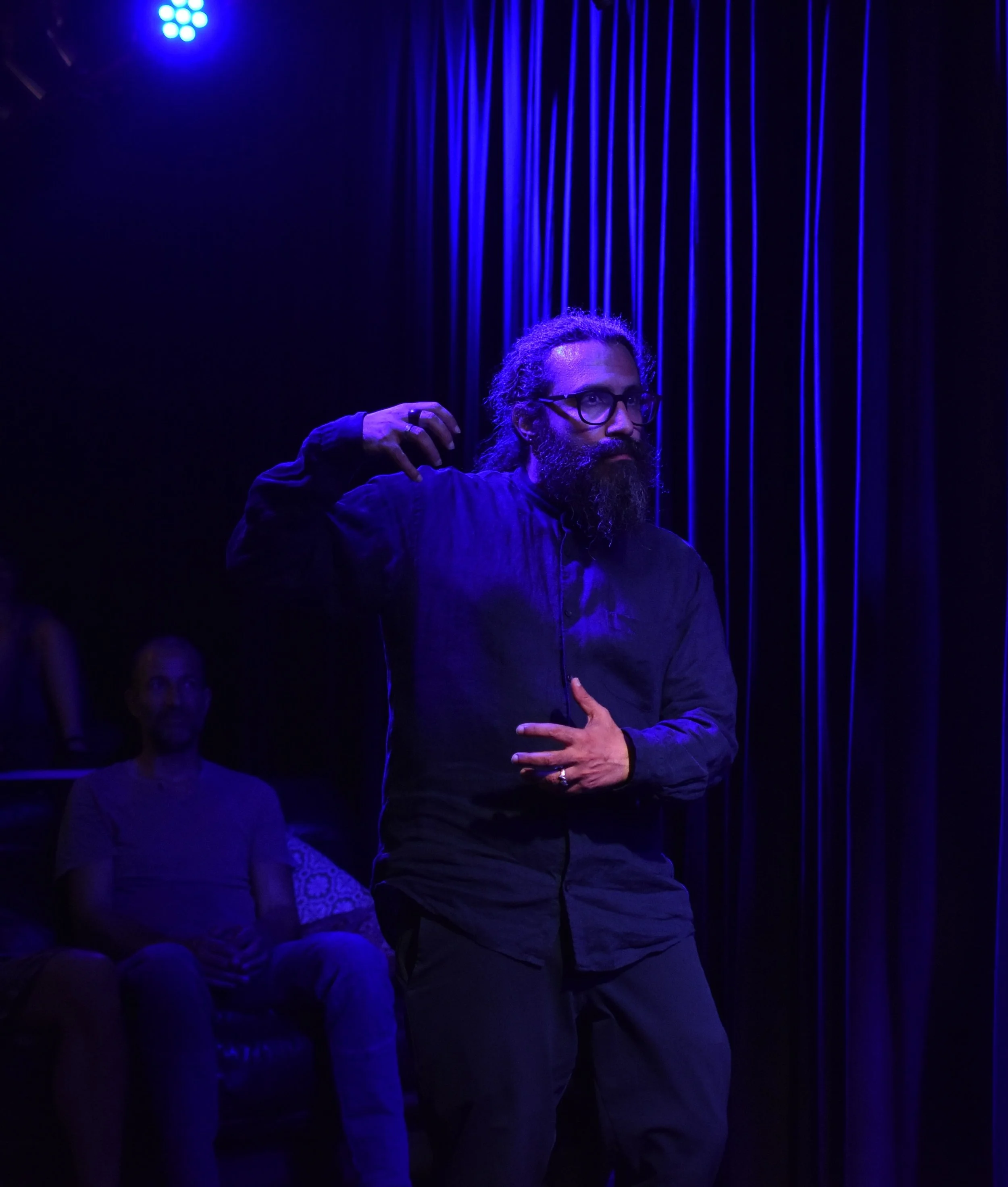
From Pearls on a String at Mezrab. Photo by Alborz Sahebdivani
Recently, I was presented with a new argument for such acts of censorship, and it was the first time I heard that argument and there was a lot of merit to it, so it got me thinking about this whole thing again. The argument is that improv is nothing like a scripted theater play or a movie because when you are creating a piece of theater or movie, you have the luxury of time and research that you don’t have in improv. When that research informs your creation, then you can make well-educated choices of characters and plot points that target certain social and political justice issues without being insulting to the audience members or the issues themselves (this came as a response to the arguments that are presented in the first reflection on this issue here). And when I heard it, my mind instantly went “Boom! This is true. Time and research. Shit! And I had never thought about that.” Then, something didn’t sit well with me. Why am I able to tell improvised stories without ever insulting an individual, a group, or a cause? And as always, whenever I ask myself that, it is followed by “If I can do it, anyone should be able to if they want to.”
And that is when it hit me again. When something gets this complicated, a good starting point to approach it is going back to the basics. And in the very basics of improv is your definition of improv. If for you, improv players are representing their own selves, ideas, and politics, and in that they are also being themselves, then yes. That argument totally makes sense.
If for you, improv is a form of theater, and thus, it is telling a story that has parallels in real life in one way or another. If it is a form of theater in which the audience members suspend their disbelief while the performers create a story, PLAY CHARACTERS as truthfully as possible to those characters and to how they exist in real life, and co-direct said play. If for you, the lack of research into a certain topic or your minimal knowledge of it is all you possess to create that story (to the top of your humanity and intelligence) is A FEATURE AND NOT A BUG. If for you, any research you do to create a story will always stay limited and work-in-progress anyway. If for you, good theater, like life exists in the grey area and nuances of characters and stories as opposed to polarized/polarizing, caricature stereotypes, then that argument does not stand.
And that definition of improv takes us back to the basics or good improv; good storytelling, good directing, good acting, and just good… theater. If you are making bad improv, it sucks whether you are being politically correct or not. If you do not have a grasp of the basics and do not return to them regularly to make sure they’re still in the foundation of your work, then the problem exists way before we get to the issues, topics, causes, and words. It exists in the craft.